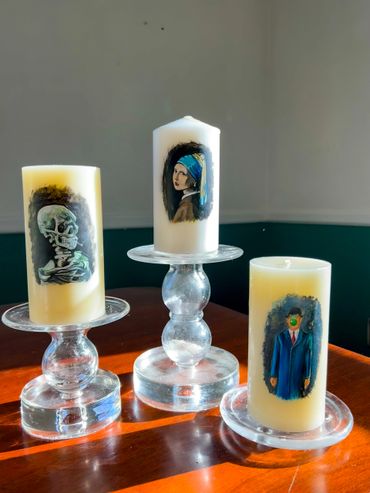
Unlike a canvas set apart on a wall, a candle enters life. It inhabits spaces fine art has rarely been invited to—resting on a piano, a bedside table, a quiet corner of a living room. It allows beauty to appear not only where it is expected, but in the hidden, intimate places where life is actually lived.
Beauty encountered daily, in silence and in private, orders the inner life. It is received rather than displayed, inviting the collector to rise and become more fully human.
There is a quiet paradox at the heart of these works, rooted in the vulnerability of wax itself. To fully experience them, they must slowly disappear—burning, yet not consumed. Like flowers arranged or incense burned, this is not an act of destruction, but of participation: an intimacy that unfolds over time. Even when preserved as sculpture, the material remains subject to heat, touch, and passing moments, reminding us that impermanence is not an exception, but a condition of beauty.
In accepting this condition, the viewer enters a deeper relationship with the work—one that extends beyond observation and invites transformation.
Beauty is never truly possessed.
It is entrusted to us for a time.
Beauty that ends with the object has failed.
Beauty that reshapes a life has been stewarded well.
Ardebat nec consumebatur — Exodus 3:2